
Automation does not always require a purpose-built machine. When standard equipment can meet the required cycle time, quality level and production volume, it may offer the simpler solution. The case for custom machine automation becomes stronger when the production process has requirements that standard equipment cannot accommodate effectively.
For manufacturers in Malaysia, that point may arise when manual work limits output, product quality varies between operators, several operations need to run within one station, or new equipment must integrate with an existing production line.
In these situations, engineers can develop an automation system around the actual product, process, factory layout and production target. Whether that additional engineering makes commercial sense depends largely on the problem the factory needs to solve.
Understanding Custom Machine Automation
Custom machine automation refers to an automated production system engineered for a specific manufacturing process, product or workflow rather than built around a fixed, standard configuration.
The scope varies considerably. A machine may automate a single repetitive operation, while a larger system may combine component feeding, assembly, screwing, dispensing, inspection, sorting and material handling within the same production cell.
Consider a component that requires orientation, assembly, adhesive dispensing and a final visual check. Separate machines could handle each operation, but the manufacturer would still need to move and position the component between processes. A custom system can bring those stages together and control the sequence as one workflow.
CAD Work Engineering’s custom machine automation solutions cover applications such as inspection, assembly, screwing, glueing, sieving, depowdering and material handling, with configurations tailored to different manufacturing requirements.
Six Signs a Production Process May Need a Custom-Built System
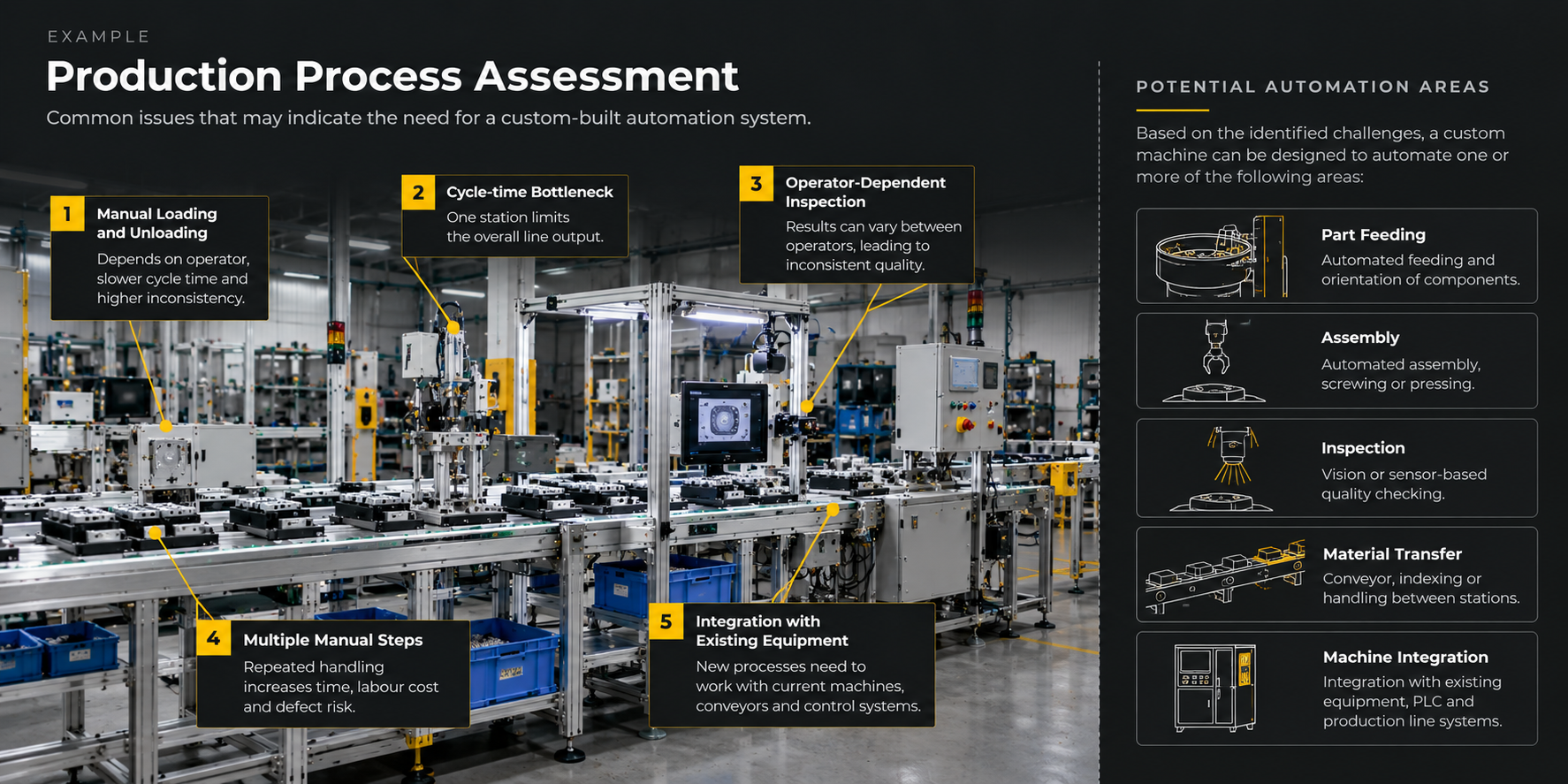
The need for custom automation usually becomes clearer when a factory examines where production loses time, consistency or control. Several situations tend to make a purpose-built system worth investigating.
1. Manual Work Is Restricting Production Capacity
Manual production can remain effective for low-volume or highly variable work. Difficulties tend to emerge when demand increases but the process cannot maintain the required output without adding more operators or shifts.
A recurring bottleneck at one station is particularly significant. Even if the rest of the line has spare capacity, that single operation can restrict total production output.
Automation may relieve the constraint by performing repetitive operations at a defined cycle time. Where the process allows it, engineers can also combine several manual steps within one machine rather than automating each step separately.
2. Process Results Vary Between Operators
Some operations depend heavily on positioning, torque, dispensing volume, measurement or visual judgement. When different operators produce noticeably different results, maintaining a stable process becomes more difficult.
Recurring defects or rework may therefore point to a process-control issue rather than a simple labour shortage.
Programmed motion, sensors, torque controls and machine vision allow an automated system to perform or verify an operation against defined parameters. For quality-critical processes, an inspection machine can also check component presence, dimensions or defects as part of the production sequence.
3. Standard Equipment Does Not Match the Application
Standard machines work well when the product and process fall within their intended operating range. Unusual component geometry, specialised tooling, multiple product variants or a non-standard production sequence can make that fit less straightforward.
Adapting the factory around unsuitable equipment may introduce additional fixtures, handling stages or manual intervention. Those compromises can reduce some of the efficiency that automation was meant to create.
With a custom machine, engineers can develop the tooling, controls, dimensions and operating sequence around the application itself. This provides greater freedom when the process cannot readily conform to a standard machine configuration.
4. Multiple Operations Need to Function as One Process
The engineering challenge becomes more complex when automation extends beyond a standalone operation.
For example, one production cell may need to:
- Feed and orient components
- Confirm that the correct component is present
- Complete an assembly or fastening operation
- Dispense adhesive or another material
- Inspect the completed process
- Separate non-conforming parts
- Transfer accepted parts to the next station
Each function must operate at the right time and exchange the necessary signals with the rest of the system. The project therefore involves more than combining several machines physically.
Mechanical design, PLC or PC programming, electrical wiring, fabrication, testing and debugging all contribute to the performance of the finished system. CAD Work Engineering provides these capabilities through its engineering and automation services.
5. Existing Production Equipment Still Needs to Be Retained
Replacing an entire production line is not always practical. A factory may have reliable equipment upstream and downstream while one intermediate process remains slow or labour-intensive.
Purpose-built automation can address that specific stage while working within the available floor space and material flow. Engineers can also account for the position and operating requirements of neighbouring equipment during the machine design process.
Early planning becomes particularly useful when the new system needs to exchange control signals or production information with existing machines.
6. Quality Control Requires Better Inspection or Traceability
Production speed is only one reason to automate. Some manufacturers need better visibility over what happens during each process.
A production team may need to verify that a component is present, confirm an assembly step, detect a defect or record whether a process remained within specified parameters.
Sensors, machine vision and control systems can perform these checks during production rather than relying solely on inspection after the process has finished. Where the application requires it, the system may also capture relevant process information for quality monitoring and traceability.
CAD Work Engineering incorporates AI machine vision and robotic system design into automation applications involving areas such as defect detection, assembly verification and dimensional measurement.
Standard Equipment or Custom Automation?
Neither approach is inherently better. The practical choice depends on how closely available equipment matches the manufacturing requirement.
| Consideration | Standard Machine | Custom Machine Automation |
|---|---|---|
| Production Process | Well suited to common or standardised applications | Developed around a specific production sequence |
| Product Variations | Operates within predefined specifications | Can accommodate application-specific components or multiple variants |
| Integration | The production process may need to adapt to the equipment | The system can be developed around existing equipment and workflows |
| Development Time | Usually shorter when a suitable machine is readily available | Includes engineering, fabrication, programming, testing and commissioning |
| Configuration | Limited to available models and options | Allows application-specific tooling, controls and functions |
Where a standard machine already achieves the required output, accuracy and integration, additional custom engineering may offer limited value. A purpose-built system becomes easier to justify when the application contains requirements that available equipment cannot address without significant compromise.
What a Custom Automation System Can Include
Custom automation does not necessarily mean a large, fully automated production line. A project may involve a dedicated workstation, a semi-automated machine or a multi-process cell, depending on the production requirement.
Typical functions include:
- Automated Assembly: Positioning and joining components according to a controlled production sequence.
- Automated Screwing: Performing repetitive fastening operations with controlled positioning and torque requirements.
- Glueing and Dispensing: Applying adhesive or other materials consistently at specified locations.
- Machine Vision: Detecting defects, checking component presence or orientation, and carrying out dimensional verification.
- Robotic Handling: Moving, positioning or assembling components where programmable motion suits the application.
- Conveyor Systems: Transferring products between processes using belt, roller or chain configurations.
- Jigs and Fixtures: Locating and holding components accurately during assembly, machining or inspection.
- Machine Controls: Managing production sequences through PLC or PC-based programming, sensors and related control hardware.
The combination depends on what the production process requires. More technology does not automatically produce a better machine; every additional function introduces cost, engineering work and maintenance requirements of its own.
From Production Requirement to Working Machine
Custom automation development begins with understanding the process rather than selecting hardware. Before engineers determine the machine layout or control architecture, they need a clear picture of the product, current workflow and expected result.
A typical project progresses through several stages:
- Process Assessment: Identify the bottleneck, quality issue, manual dependency or other production constraint.
- Requirement Definition: Establish the product specifications, process sequence, target cycle time, accuracy, inspection criteria, available space and integration points.
- Concept Development: Determine how the machine will load, position, process, inspect and transfer the product.
- Detailed Engineering: Develop the mechanical design, tooling, controls, electrical system and relevant safety provisions.
- Fabrication and Assembly: Manufacture the required parts and assemble the machine.
- Programming and Testing: Develop the control sequence and evaluate the system against its agreed operating requirements.
- Installation and Commissioning: Integrate the equipment into the production environment and verify its operation under working conditions.
Clear requirements make these stages easier to manage. When cycle time, product variations, inspection criteria and integration needs are defined early, both the manufacturer and engineering team have measurable targets against which to assess the finished system.
Information That Helps Engineers Develop the Right Solution
An initial automation enquiry does not need to contain a complete engineering specification. Even so, a few pieces of production information can make the first technical discussion considerably more useful.
| Information | How It Helps |
|---|---|
| Product or Component | Provides the basis for handling, tooling, fixture and machine requirements. |
| Current Process | Shows how production works today and where the main constraints occur. |
| Target Output or Cycle Time | Establishes a measurable performance target for the proposed system. |
| Product Variants | Indicates whether the machine requires changeovers, adjustable tooling or multiple operating recipes. |
| Quality Requirements | Defines any inspection, measurement, verification or rejection functions. |
| Available Floor Space | Influences the machine footprint, layout and material flow. |
| Existing Equipment | Reveals mechanical, electrical and control-system integration requirements. |
Product samples, drawings, process videos and existing cycle-time records can add useful context as well. They allow the engineering team to examine the actual application before developing a machine concept.
Evaluating the Business Case for Custom Automation
There is no single price for custom machine automation because the engineering scope changes from one application to another. A dedicated single-process workstation bears little resemblance to a multi-station system that combines robotics, machine vision, inspection and production-data functions.
Machine price is therefore only one part of the investment assessment. The operational cost of the existing process provides equally useful context.
Relevant factors may include:
- Labour currently required for the process
- Production volume and target cycle time
- Defect, scrap and rework costs
- Downtime associated with the current operation
- Inspection and quality-control requirements
- Additional capacity that automation could provide
- Maintenance and technical support requirements
- Likely product changes or future production expansion
For a stable, low-volume process with frequent product changes, full automation may offer relatively little advantage. The business case can look quite different when a repetitive, high-volume operation has a measurable capacity constraint or recurring quality problem.
For a broader discussion of financial and operational considerations, CAD Work’s guide to automation machine ROI in Malaysia explores how manufacturers can assess the wider impact of an automation investment.
Different Industries, Different Automation Requirements
Custom automation applies across many manufacturing sectors, but the engineering priorities are rarely identical.
Semiconductor and electronics production may involve small-component handling, precision assembly and vision inspection. Automotive applications can place greater emphasis on fastening, material handling and process repeatability. Medical-device manufacturing may require tighter inspection and traceability controls, while food and beverage production introduces its own handling and production considerations.
CAD Work Engineering works with automation applications across industries including semiconductor, electronics, medical, automotive, aircraft-related manufacturing, and food and beverage.
The diversity of these applications illustrates why a custom system begins with the production requirement. Two factories may both want to increase output, yet require completely different machine concepts to achieve it.
Choosing a Custom Machine Automation Company in Malaysia
The quality of a custom automation project depends on more than the machine concept. The provider also needs the engineering capability to turn that concept into equipment that performs reliably on the production floor.
Several areas help distinguish the capabilities of different custom machine automation companies:
- Machine Design: The ability to translate production requirements into a workable mechanical and automation concept.
- Programming: PLC, PC or robotic programming capability appropriate to the proposed system.
- Fabrication: Access to the machining and fabrication resources needed for custom parts, tooling and fixtures.
- System Integration: Experience connecting new equipment with existing machines and production workflows.
- Inspection Technology: The ability to incorporate sensors or machine vision where quality verification forms part of the process.
- Testing: A defined approach for evaluating cycle time, machine functions and quality requirements before handover.
- Technical Support: Engineering support during installation, commissioning and subsequent machine operation.
CAD Work Engineering combines machine design with programming, electrical wiring and fabrication services. Its in-house machining facilities include CNC milling, lathe, EDM, precision grinding and tapping capabilities.
Manufacturers comparing engineering partners can also refer to 7 Top Factors to Consider When Choosing a Machine Manufacturer in Malaysia for a broader supplier-evaluation framework.
Deciding Whether Custom Automation Fits Your Production Process
A custom-built system has the strongest case when it addresses a clearly defined production constraint that standard equipment cannot solve effectively.
Persistent bottlenecks, inconsistent process results, complex manual operations and difficult integration requirements all provide useful reasons to investigate custom automation. A straightforward process with suitable standard equipment available may require far less engineering.
In practice, the existing production process provides the clearest starting point. Its cycle time, quality issues, manual steps, space limitations and integration requirements reveal where automation could add measurable value and where it may simply introduce unnecessary complexity.
Once those conditions are understood, the discussion with an automation engineer becomes much more specific. Both sides can evaluate what needs to change, what the machine needs to achieve and whether a custom-built system offers a practical route to that result.
Frequently Asked Questions
What is custom machine automation?
Custom machine automation is an automated production system engineered around a specific manufacturing process, product or workflow. Its tooling, controls, layout and functions can be developed to suit requirements that standard equipment may not accommodate.
When does a manufacturer need a custom automation machine?
Custom automation becomes relevant when manual work creates a persistent bottleneck, process results vary, standard machines do not fit the application, or several production stages need to operate as one integrated system.
Is custom automation better than an off-the-shelf machine?
It depends on the application. Standard equipment may be the more efficient choice when it already meets the required output, accuracy and integration needs. Custom automation becomes more useful when the production process contains requirements that available equipment cannot address effectively.
Can a custom automation machine integrate with an existing production line?
Yes. Engineers can develop a custom system around existing equipment, factory layout and production flow. The project needs to account for the relevant mechanical, electrical, control and data connections between the new and existing equipment.
What information is useful when requesting a custom automation proposal?
Useful information includes the product or component, current production process, production volume, target cycle time, product variants, quality requirements, available floor space and any existing equipment that needs to connect with the new system.
Discuss Your Custom Automation Requirements with CAD Work Engineering
CAD Work Engineering Sdn Bhd develops custom machine automation for specific manufacturing processes, with capabilities spanning machine design, programming, electrical wiring, fabrication, AI machine vision and robotic systems.
If you are evaluating automation for a production bottleneck, repetitive manual operation, quality-control issue or equipment-integration requirement, our engineering team can review the application and discuss a suitable approach.
Disclaimer:
This article is intended for general informational purposes only and may not represent the full range of services offered by CAD Work Engineering Sdn. Bhd. For tailored advice specific to your needs, please consult a qualified professional or contact us directly. While we make every effort to ensure the accuracy and completeness of the information provided, CAD Work Engineering Sdn. Bhd. makes no guarantees and accepts no responsibility for any errors or omissions.