
Automation continues to reshape modern manufacturing. As industries demand higher efficiency, precision, and scalability, integrating robotic systems into custom machine design has become a strategic move for companies looking to stay competitive.
Rather than relying solely on manual processes or semi-automated equipment, businesses are now incorporating robotics directly into purpose-built machines to enhance performance, reliability, and long-term productivity.
What Is a Robotic System in Custom Machine Design?
A robotic system in custom machine design refers to the integration of programmable robotic units such as articulated arms, SCARA robots, gantry systems, or collaborative robots into specially engineered industrial equipment.
These systems are designed to:
- Perform repetitive or high-precision tasks
- Increase operational efficiency
- Improve production consistency
- Reduce dependency on manual labor
- Enhance workplace safety
When properly integrated, robotic systems function as a core component of a fully automated production solution.
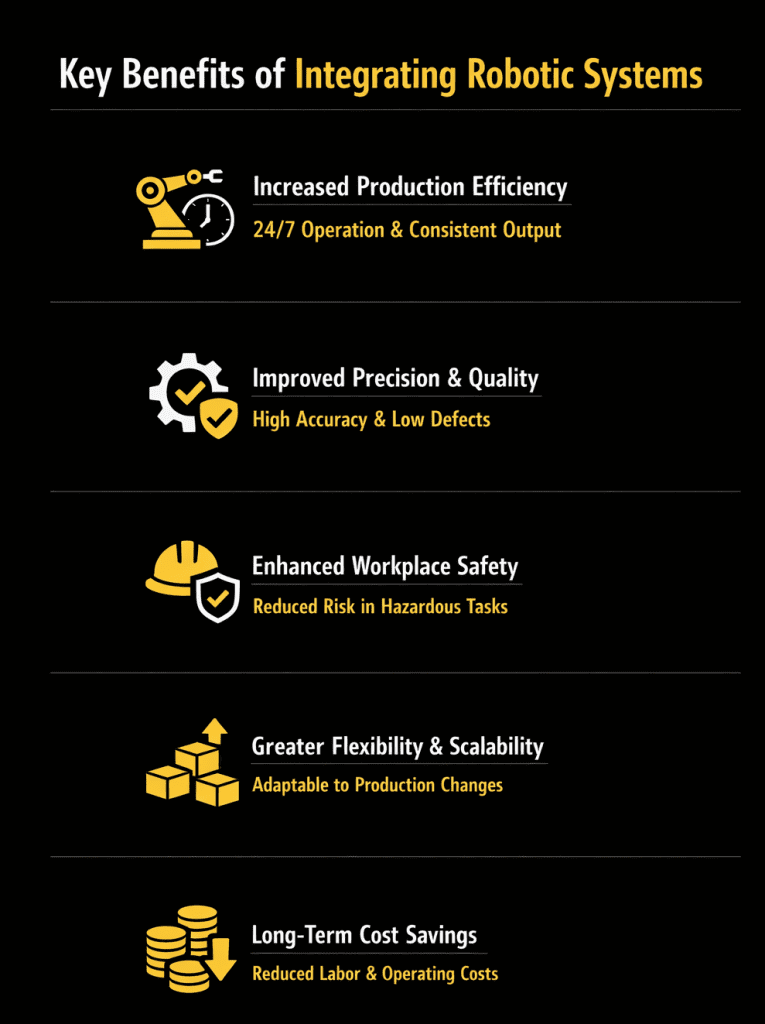
Key Benefits of Integrating Robotic Systems
Increased Production Efficiency
Robots can operate continuously with minimal downtime. Unlike manual operations, robotic systems:
- Maintain consistent cycle times
- Operate 24/7 with minimal fatigue
- Deliver predictable output levels
This improves throughput and accelerates return on investment (ROI).
Improved Precision and Product Quality
In industries such as electronics, automotive, and medical manufacturing, precision is critical. Robotic systems offer high repeatability and accuracy, ensuring consistent performance across production cycles.
Benefits include:
- Precise positioning and alignment
- Consistent assembly results
- Reduced human error
- Lower defect and rejection rates
This leads to stronger quality control and improved customer satisfaction.
Enhanced Workplace Safety
Robotic integration reduces the need for human involvement in hazardous or physically demanding tasks. Robots can safely handle:
- Heavy lifting
- High-temperature operations
- Repetitive strain processes
- Exposure to harmful materials
By automating these tasks, companies can lower workplace injury risks and improve compliance with safety standards.
Greater Flexibility and Scalability
Modern robotic systems are programmable and adaptable. When incorporated into custom machines, they allow manufacturers to:
- Adjust to multiple product variations
- Modify production workflows easily
- Scale output based on demand
- Adapt to future product changes
This flexibility is particularly beneficial for companies handling diverse product lines or evolving market requirements.
Long-Term Cost Savings
Although robotic integration requires initial investment, the long-term financial benefits are significant:
- Reduced labor costs
- Lower operational errors
- Decreased material waste
- Improved energy efficiency
- Reduced downtime
Over time, these savings contribute to stronger profit margins and operational stability.
Common Applications of Robotic Systems in Custom Machines
Robotic systems are widely used in custom-built machinery for applications such as:
- Pick and place operations
- Automated packaging systems
- Robotic welding stations
- Precision assembly processes
- Palletizing and material handling
These integrations enhance both speed and consistency across various production environments.
Real‑World Robotics Success Story
A recent warehouse automation project demonstrates the real impact of robotic systems on efficiency and accuracy. By integrating retrofittable robotic systems into existing warehouse operations, the facility was able to modernize workflows and achieve significant results. Key improvements included:
- 5× increase in overall productivity, enabling faster order fulfillment
- 10× improvement in handling accuracy, reducing errors and damaged goods
- Reduced worker fatigue and safety risks, as robots handled repetitive and physically demanding tasks
- Scalable operations, with the flexibility to expand the system as demand grows
The project also leveraged digital twin simulation to test robotic workflows before deployment, ensuring minimal disruption to ongoing operations. This case illustrates how robotic integration can deliver measurable efficiency, precision, and safety benefits in a real industrial setting.
Source: Retrofittable robotic automation system modernizes existing warehouse operations
Why Businesses Are Embracing Robotic Integration
Manufacturers today face rising labor costs, skilled workforce shortages, and increasing global competition. Integrating robotic systems into custom machine design allows companies to remain competitive while maintaining consistent production standards.
Engineering firms like Cadwork Engineering provide tailored automation solutions that incorporate robotics based on specific operational needs. By designing machines with integrated robotic systems, manufacturers can future-proof their production lines and adapt to changing industry demands.
Why Choose Cadwork Engineering?
Choosing the right engineering partner is essential when integrating robotic systems into custom machine design. Cadwork Engineering combines technical expertise, practical industry experience, and end-to-end project management to deliver automation solutions that are efficient, scalable, and built for long-term performance.
Key reasons to choose Cadwork Engineering:
- Custom-designed machines tailored to your production requirements
- Seamless robotic system integration for improved efficiency and precision
- Complete support from design and fabrication to installation and commissioning
- Solutions focused on productivity, reliability, and ROI
- Strong local technical support and after-sales service in Malaysia
With a commitment to quality and innovation, Cadwork Engineering helps businesses enhance automation capabilities and stay competitive in a rapidly evolving manufacturing landscape.
Conclusion
Integrating robotic systems into custom machine design delivers measurable advantages in efficiency, precision, safety, and cost control. As automation becomes a core driver of industrial growth, companies that invest in robotic integration position themselves for long-term success.
Businesses seeking to enhance their production capabilities should consider working with experienced automation specialists to develop custom robotic-enabled solutions that align with their operational goals.
📞 Contact Us Today:
Frequently Asked Questions (FAQ)
1. What is a robotic system in custom machine design?
A robotic system in custom machine design integrates programmable robotic units such as robotic arms, SCARA robots, gantry systems, or collaborative robots into purpose-built machinery to perform high-precision, repetitive, or complex tasks.
2. How do robotic systems improve production efficiency?
Robotic systems operate continuously with consistent cycle times, minimal downtime, and high precision, resulting in faster output, reduced errors, and predictable production levels.
3. Can robotic systems be customized for different industries?
Yes. Robotic systems can be tailored for electronics, automotive, medical devices, food processing, and other industries, adapting to unique workflows, product variations, and production requirements.
4. What safety benefits do robotic systems provide?
By handling hazardous, heavy, or repetitive tasks, robotic systems reduce human exposure to workplace risks, minimize fatigue, and help companies comply with safety standards.
5. Why should a company choose Cadwork Engineering for robotic system integration?
Cadwork Engineering delivers custom-designed machines with seamless robotic integration, end-to-end project support, scalable solutions, and reliable local service in Malaysia, ensuring long-term efficiency, precision, and ROI.
Disclaimer:
This article is intended for general informational purposes only and may not represent the full range of services offered by CAD Work Engineering Sdn. Bhd. For tailored advice specific to your needs, please consult a qualified professional or contact us directly. While we make every effort to ensure the accuracy and completeness of the information provided, CAD Work Engineering Sdn. Bhd. makes no guarantees and accepts no responsibility for any errors or omissions.