
In today’s competitive manufacturing landscape, precision and consistency are more critical than ever. Traditional manual inspection methods are no longer sufficient to meet high production demands and strict quality standards. This is where AI machine vision plays a transformative role in modern machine design.
By integrating artificial intelligence with advanced imaging systems, manufacturers can achieve higher accuracy, reduce defects, and enhance overall production efficiency.
What is AI Machine Vision?
AI machine vision combines industrial cameras, sensors, and artificial intelligence algorithms to automatically inspect, analyze, and verify products during manufacturing. Unlike traditional vision systems that follow fixed rules, AI-powered systems learn from data and improve over time.
This makes them ideal for complex inspection tasks where precision and adaptability are required.
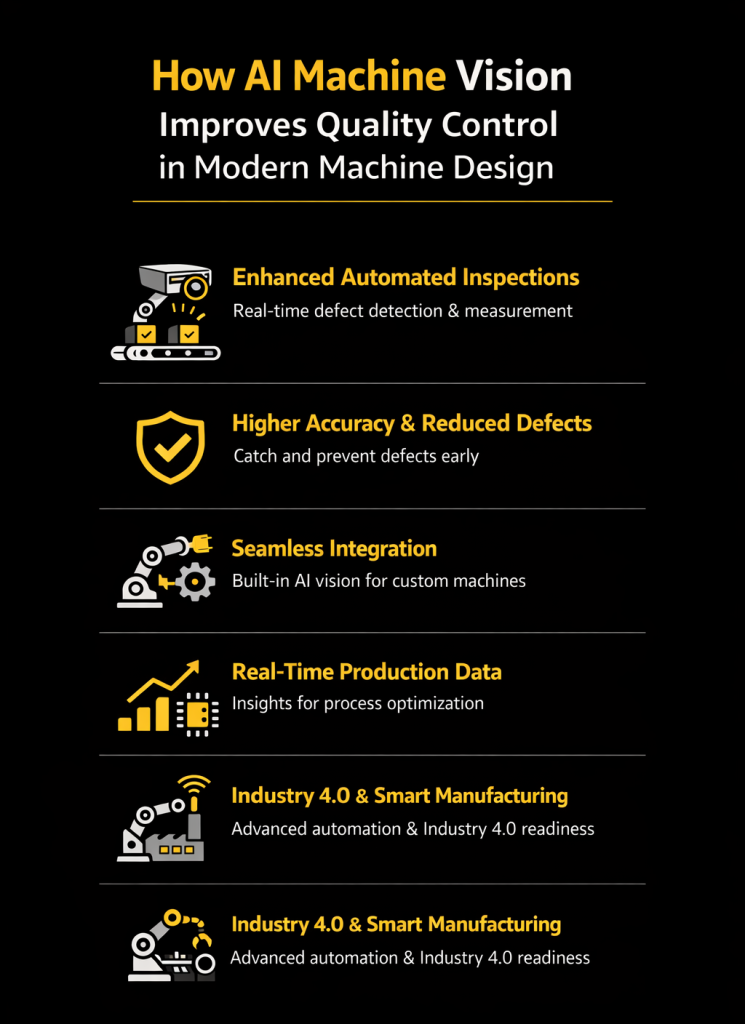
Enhancing Quality Control Through Automation
One of the biggest advantages of AI machine vision is its ability to perform real-time quality inspections without slowing down production lines.
Key improvements include:
- Detecting surface defects, cracks, or misalignments
- Identifying incorrect assembly or missing components
- Verifying dimensions and tolerances
- Ensuring labeling and packaging accuracy
By automating these tasks, manufacturers reduce reliance on manual inspections, minimizing human error and improving consistency.
Higher Accuracy and Reduced Defects
AI-driven systems can analyze thousands of images per minute with exceptional precision. This allows manufacturers to:
- Catch defects early in the production process
- Reduce scrap rates and material waste
- Prevent faulty products from reaching customers
Early detection significantly lowers rework costs and protects brand reputation.
Seamless Integration into Modern Machine Design
AI machine vision is not just an add-on. It is increasingly becoming a core component of custom machine design. When integrated during the design phase, it enables:
- Smarter automation systems
- Improved workflow optimization
- Data-driven production monitoring
- Predictive quality control
Forward-thinking machine manufacturers incorporate AI vision systems directly into their automation solutions to ensure long-term efficiency and scalability.
Real-Time Data for Smarter Decisions
Modern AI vision systems collect valuable production data, providing insights such as:
- Defect trends
- Production bottlenecks
- Equipment performance metrics
This data helps manufacturers make informed decisions, optimize processes, and continuously improve operations.
Supporting Industry 4.0 and Smart Manufacturing
AI machine vision aligns perfectly with Industry 4.0 initiatives, enabling smarter factories with interconnected systems. When combined with robotics and automation, it creates fully intelligent production lines capable of self-monitoring and self-correcting.
This is especially important for industries requiring high precision, such as electronics, automotive, medical devices, and advanced manufacturing.
Why AI Machine Vision Matters in Modern Machine Design
Integrating AI machine vision into machine design offers long-term benefits:
- Improved product quality
- Faster inspection speeds
- Reduced labor costs
- Greater production consistency
- Enhanced competitiveness in global markets
For companies looking to upgrade their production capabilities, investing in intelligent inspection systems is no longer optional, it is a strategic necessity.
Why Choose Cadwork Engineering?
Cadwork Engineering specializes in custom machine design and automation solutions, integrating advanced technologies such as AI machine vision into modern manufacturing systems.
With expertise in precision engineering, automation integration, and end-to-end project execution, Cadwork delivers:
- Tailored machine design solutions
- AI-powered inspection systems
- Seamless integration with robotics and automation
- Comprehensive testing and commissioning
- Reliable after-sales support
By incorporating AI machine vision into your production line, Cadwork Engineering helps ensure superior quality control, operational efficiency, and long-term performance.
Conclusion
AI machine vision is revolutionizing quality control in modern machine design. By combining intelligent inspection systems with automation, manufacturers can achieve higher accuracy, reduce defects, and improve overall productivity.
As manufacturing standards continue to evolve, integrating AI-driven quality control solutions will be essential for businesses aiming to stay competitive and future-ready.
📞 Contact Us Today:
Frequently Asked Questions (FAQ)
1. What is AI machine vision in manufacturing?
AI machine vision is an advanced inspection system that uses industrial cameras, sensors, and artificial intelligence algorithms to automatically detect defects, verify dimensions, and ensure product quality during production. It enables faster, more accurate inspections compared to manual methods.
2. How does AI machine vision improve quality control?
AI machine vision improves quality control by performing real-time inspections with high precision, detecting defects early, reducing human error, and minimizing scrap and rework. This leads to improved product consistency and lower production costs.
3. Can AI machine vision be integrated into custom machine design?
Yes. AI machine vision can be integrated directly into custom machine design during the development phase. This allows manufacturers to create smarter automation systems that combine inspection, data collection, and production optimization within a single solution.
4. Which industries benefit most from AI machine vision systems?
Industries such as electronics, automotive, medical devices, food processing, and industrial manufacturing benefit significantly from AI machine vision. These sectors require high precision, strict quality standards, and consistent inspection processes.
5. What are the advantages of AI machine vision over manual inspection?
Compared to manual inspection, AI machine vision offers higher accuracy, faster inspection speeds, continuous 24/7 operation, data-driven analysis, and reduced labor dependency. This results in improved efficiency, lower defect rates, and better overall productivity.
Disclaimer:
This article is intended for general informational purposes only and may not represent the full range of services offered by CAD Work Engineering Sdn. Bhd. For tailored advice specific to your needs, please consult a qualified professional or contact us directly. While we make every effort to ensure the accuracy and completeness of the information provided, CAD Work Engineering Sdn. Bhd. makes no guarantees and accepts no responsibility for any errors or omissions.